04 ——
The Craft
Reporting & Analytics
The science is pulling the right numbers from the right places. The art is knowing which ones matter, what they're telling you, and how to communicate that clearly to whoever needs to act on it. Data that explains something — not data that just exists.
…as you've already missed today.
The science is pulling the right numbers from the right places. The art is knowing which ones matter, what they're telling you and how to communicate that clearly to whoever needs to act on it. Data that explains something — not data that just exists.
This is also a strategic and consultancy service. Not necessarily hands-on execution — sometimes the most valuable thing is an independent perspective on what the data is showing, what it means for the business, and what to prioritise next.
A lot of the metrics the SEO industry has relied on are no longer meaningful. Rankings shouldn't have been a primary metric anyway — what you see in your location, on your device, at this time of day, based on your search history, isn't what the person next to you sees. Personalisation made rankings a broad snapshot at best.
AI Overviews have compounded this. The correlation between impressions, clicks and CTR is increasingly unreliable for informational queries. Sites focused on informational content will see visits decline regardless of how well they're optimised — because the answer is being served before the click. Just because there are no fish in the glass you've taken from the ocean, doesn't mean there are no fish.
What matters instead: referring terms (how many relevant queries is the site appearing for — qualified by intent, not just volume), average position (a directional indicator, not a precise truth — understood as such), engagement quality (session depth, conversion rate, revenue per session) and channel contribution across organic, paid, direct and AI-referred traffic.
Intent distribution matters too. The chart below shows how search intent differs markedly between Google and ChatGPT — with transactional queries far more dominant on ChatGPT than on Google. Understanding where your audience is searching, and what they're looking for when they get there, shapes everything from content strategy to how you measure success.
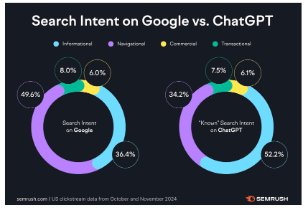
Source: SEMrush — US clickstream data, October & November 2024
Reporting and consultancy follows a repeatable cycle — the same framework whether it's a one-off audit or an ongoing engagement.
Performance analysis, coverage monitoring, index status and crawl errors. Reading GSC properly — understanding what it shows, what it deliberately obscures, and what the gaps actually mean for the site.
GA4 setup, event configuration, conversion tracking, channel groupings, exploration reports. Including AI traffic tracking so visits from ChatGPT and other AI platforms can be evaluated alongside organic.
Understanding what's actually driving traffic and revenue across organic, paid, direct, referral and AI-referred channels. Where the attribution model is obscuring rather than clarifying the picture — and how to fix it.
Reporting built around what matters, not what the tool shows by default. Looker Studio dashboards tailored for different audiences — from executive overview to technical detail. Written for the people who'll act on it.
An independent perspective on what the data is showing and what it means for strategy. Not just reporting what happened — advising on what to do next, what to prioritise and what the numbers aren't telling you.
Analysing visitor behaviour across the site via Microsoft Clarity and GA4 — path analysis, channel contribution, low abandonment and high engagement. Insights that benefit all channels, not just organic.
Start with what you're currently measuring and what decisions it's informing. We'll work out where the gaps are from there.